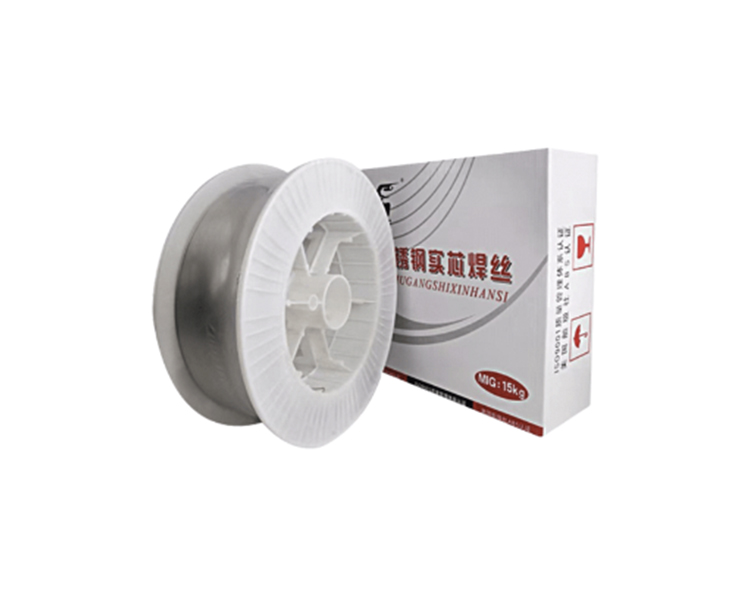
Common grades: ER307Si, ER308, ER308L, ER308LSi, ER309L, ER309LSi, ER316L, ER316LSi, ER310, ER321, ER347, ER410, ER430, ER430LNb, ER630, ER2209, ER304.
Wire diameter: Φ0.8mm – Φ1.6mm
Packing: 1kg/box, 5kg/box, 15kg/box, 20kg/box, 100kg/drum, 200kg/drum
Application Principle: The welding wire acts as an electrode, and the arc burning between the continuously fed welding wire and the workpiece serves as the heat source to melt the welding wire and base metal. During welding, shielding gas (such as Ar + 1~3% O₂) is continuously delivered to the welding zone through the welding gun nozzle, protecting the arc, molten pool and adjacent base metal from harmful air. The welding wire melts continuously and transfers into the molten pool in droplet form, fuses with the molten base metal and solidifies to form a weld seam.
| Product Name | AWS standards | YB Standard | |
|---|---|---|---|
| 304 | — | 06Cr19Ni10 | |
| 307Si | — | H09Cr21Ni9Mn7Si | |
| 307Ti | — | H09Cr19Ni9Mn7Ti | |
| 308H | ER308H | H07Cr21Ni10 | |
| 308L | ER308L | H022Cr21Ni10 | |
| 308LSi | ER308LSi | H022Cr21Ni10Si | |
| 309L | ER309L | H022Cr24Ni13 | |
| 309LSi | ER39LSi | H022Cr24Ni13Si | |
| 309Mo | ER309Mo | H10Cr24Ni13Mo2 | |
| 309LMo | ER309LMo | H022Cr24Ni13Mo2 | |
| 309LMoSi | ER309LMoSi | H022Cr24Ni13Mo2Si | |
| 310 | ER310 | H11Cr26Ni21 | |
| 310Mo | ER310Mo | H11Cr26Ni21Mo2 | |
| 310S | ER310S | H07Cr26Ni21 | |
| 316 | ER316 | H08Cr19Ni12Mo2 | |
| 316H | ER316H | H07Cr19Ni12Mo2 | |
| 316L | ER316L | H022Cr19Ni12Mo2 | |
| 316LSi | ER316LSi | H022Cr19Ni2Mo2Si | |
| 316LMn | ER316LMn | H022Cr19Ni12Mo2Mn | |
| 317L | ER317L | H022Cr19Ni13Mo3 | |
| 317LSi | ER317LSi | H022Cr19Ni13Mo3Si | |
| 347 | ER347 | H08Cr19Ni10Nb | |
| 347Si | ER347Si | H08Cr19Ni10NbSi | |
| 348 | ER348 | H08Cr19Ni10Ti | |
| 410 | ER410 | H12Cr13 | |
| 420 | ER420 | H12Cr13 | |
| 430 | ER430 | H10Cr17 | |
| 2209 | ER2209 | H03Cr22Ni8Mo3N |
| Product Name | Welding wire chemical composition (%) | |||||||||
|---|---|---|---|---|---|---|---|---|---|---|
| C | Si | Mn | P | S | Cr | Ni | Mo | Cu | Others | |
| 304 | 0.08 | 1.00 | 2.00 | 0.05 | 0.01 | 18.00~20.00 | 8.00~11.00 | — | 0.75 | — |
| 308L | 0.03 | 1.00 | 2.00 | 0.05 | 0.01 | 19.00~21.00 | 9.00~11.00 | — | 0.75 | — |
| 308LSi | 0.03 | 1.00~2.50 | 2.00 | 0.05 | 0.01 | 19.00~21.00 | 9.00~11.00 | — | 0.75 | — |
| 308H | 0.04~0.10 | 1.00 | 2.00 | 0.05 | 0.01 | 19.00~21.00 | 9.00~11.00 | — | 0.75 | — |
| 309L | 0.03 | 1.00 | 2.00 | 0.05 | 0.01 | 22.00~24.00 | 12.00~14.00 | — | 0.75 | — |
| 309LMo | 0.03 | 1.00 | 2.00 | 0.05 | 0.01 | 22.00~24.00 | 12.00~14.00 | 2.00~3.00 | 0.75 | — |
| 310 | 0.20 | 1.00 | 2.00 | 0.05 | 0.01 | 25.00~27.00 | 19.00~22.00 | — | 0.75 | — |
| 316L | 0.03 | 1.00 | 2.00 | 0.05 | 0.01 | 18.00~20.00 | 10.00~14.00 | 2.00~3.00 | 0.75 | — |
| 316LSi | 0.03 | 1.00~2.50 | 2.00 | 0.05 | 0.01 | 18.00~20.00 | 10.00~14.00 | 2.00~3.00 | 0.75 | — |
| 316H | 0.04~0.10 | 1.00 | 2.00 | 0.05 | 0.01 | 18.00~20.00 | 10.00~14.00 | 2.00~3.00 | 0.75 | — |
| 317L | 0.03 | 1.00 | 2.00 | 0.05 | 0.01 | 18.00~20.00 | 11.00~15.00 | 3.00~4.00 | 0.75 | — |
| 317LSi | 0.03 | 1.00~2.50 | 2.00 | 0.05 | 0.01 | 18.00~20.00 | 11.00~15.00 | 3.00~4.00 | 0.75 | — |
| 347 | 0.08 | 1.00 | 2.00 | 0.05 | 0.01 | 18.00~20.00 | 9.00~11.00 | — | 0.75 | Nb Ta: 8×C~1.00 |
| 347Si | 0.08 | 1.00~2.50 | 2.00 | 0.05 | 0.01 | 18.00~20.00 | 9.00~11.00 | — | 0.75 | Nb Ta: 8×C~1.00 |
| 2209 | 0.03 | 1.00 | 2.00 | 0.05 | 0.01 | 21.00~23.00 | 8.50~10.50 | 2.50~3.50 | 0.75 | N: 0.10~0.25 |
| Product Name | Application | ||
|---|---|---|---|
| 304 | Main composition: 18%Cr-8%Ni | ||
| 307Si | Main constituents: 48Cr-8Ni-6Mn; suitable for nuclear submarines. It can also be used for welding dissimilar steels that are difficult to weld and prone to cracking, as well as in special applications requiring non-magnetic materials, such as bulletproof steel plates. | ||
| 307Ti | Main constituents: 18Cr–8Ni–6Mn–Ti. Compared with ER307, this alloy incorporates titanium, which significantly enhances its corrosion resistance, particularly its resistance to intergranular corrosion. | ||
| 308H | The main alloying elements are high chromium (C-18) and nickel (C-8), with a carbon content of 0.04–0.08%. It is suitable as a base material for welding 304H and can provide superior high-temperature strength. | ||
| 308L | The main composition is low-C-18Cr-8Ni, suitable for welding 18Cr-8Ni–type low-carbon stainless steel in chemical equipment, pressure vessels, food-processing machinery, fertilizer plants, and other related applications. | ||
| 308LSi | The main alloying elements are low carbon, 18% chromium, and 8% nickel, with the addition of silicon. This composition provides excellent molten-metal fluidity and produces weld beads with a smooth, aesthetically pleasing appearance, making it suitable for high-speed welding. | ||
| 309L | The main alloying elements are 22% chromium and 12% nickel, identical to ER309. It is suitable for root pass welding on carbon steel or low-alloy steel transition layers, as well as for other dissimilar metal welds. | ||
| 309LSi | The main alloying elements are 22% Cr and 12% Ni, with the addition of silicon. This composition provides excellent molten-metal fluidity and produces weld beads with a smooth, aesthetically pleasing appearance, making it suitable for high-speed welding. | ||
| 309Mo | The main composition is high C- 22Cr-12Ni-2Mo, suitable for welding Mo-containing stainless steels such as 316 and 317, and also applicable to dissimilar metal welding. | ||
| 309LMo | The main composition is low-C 22Cr–12Ni–2Mo. It is suitable for welding Mo-containing stainless steels such as 316L and 317L, and can also be used for dissimilar-metal welding. | ||
| 309LMoSi | The main alloying elements are 22% Cr, 12% Ni, and 2% Mo, with the addition of silicon. This composition provides excellent molten-metal fluidity and produces weld beads with a smooth, aesthetically pleasing appearance, making it suitable for high-speed welding. | ||
| 310 | The main composition is high-C, 25Cr–20Ni. It is suitable for welding high-temperature-resistant stainless steels such as 310S and can be used at temperatures up to 1200°C. | ||
| 310Mo | The main alloying elements are 25% Cr, 20% Ni, and 2% Mo. It is suitable for welding high-temperature-resistant stainless steels such as 310Mo and can be used at temperatures up to 1200°C. | ||
| 310S | The main composition is low-C-25Cr-20Ni, suitable for welding high-temperature-resistant stainless steels such as 310S. It can be used at temperatures up to 1200°C. | ||
| 316 | Main constituents: 18Cr-12Ni-2Mo. Suitable for welding Type 316 stainless steel, it offers excellent corrosion resistance, particularly pitting resistance. | ||
| 316H | The primary alloying elements are 18% chromium, 12% nickel, and 2% molybdenum. It is suitable for welding Type 316H stainless steel and provides superior high-temperature strength. | ||
| 316L | The primary alloying elements are low carbon, 18% chromium, 12% nickel, and 2% molybdenum. It is suitable for welding 316L stainless steel and offers excellent corrosion resistance, particularly against pitting corrosion. | ||
| 316LSi | The main alloying elements are 18% Cr, 12% Ni, and 2% Mo, with the addition of silicon. This composition provides excellent molten-metal fluidity and produces weld beads with a smooth, aesthetically pleasing appearance, making it suitable for high-speed welding. | ||
| 316LMn | The main alloying elements are low carbon, 18% chromium, 12% nickel, 2% molybdenum, and manganese. It is suitable for welding 316L stainless steel and offers excellent corrosion resistance and mechanical properties. | ||
| 317L | The main alloying elements are low carbon, 19% chromium, 13% nickel, and 3% molybdenum. It is suitable for welding 317L stainless steel and offers excellent corrosion resistance, particularly pitting resistance. | ||
| 317LSi | The main alloying elements are 19% Cr, 13% Ni, and 3% Mo, with the addition of silicon. This composition provides excellent molten-metal fluidity and produces weld beads with a smooth, aesthetically pleasing appearance, making it suitable for high-speed welding. | ||
| 347 | Main constituents: 18Cr–8Ni–Nb. The addition of niobium significantly enhances intergranular corrosion resistance and makes this filler metal suitable for welding Type 347 stainless steel. | ||
| 347Si | Main constituents: 18Cr–8Ni–Nb, with added silicon. The molten metal exhibits excellent fluidity, resulting in aesthetically pleasing weld beads, making it suitable for high-speed welding. | ||
| 348 | Main constituents: 18Cr–8Ni–Ti. The addition of titanium significantly enhances intergranular corrosion resistance and makes this filler metal suitable for welding Type 348 stainless steel. | ||
| 410 | Main component: 13Cr. Suitable for welding Type 410 stainless steel, it offers excellent corrosion resistance and mechanical properties. | ||
| 420 | Main component: 13Cr. Suitable for welding 420-grade stainless steel, it offers excellent corrosion resistance and mechanical properties. | ||
| 430 | Main constituents: 17% Cr. Suitable for welding 430-type stainless steel, it offers excellent corrosion resistance and mechanical properties. | ||
| 2209 | Main constituents: 22Cr–8Ni–3Mo–N. Duplex stainless steel, suitable for welding 2205-grade stainless steel. It exhibits excellent resistance to stress-corrosion cracking and pitting corrosion. |
 中文
中文 English
 Russia
 Korea
Korea Spanish
 French
 German
 Italian
 Thai
Thai Japanese
 Vietnamese